Rhythms and
Instruments
Vibration of Earth
and Air: Udu
I am particularly fond of this instrument, originally from Nigeria, which belongs to the idiophone family.
Its terracotta body produces an interesting repertoire of sounds, some of which resemble the sound of water.
I asked the craftsman to add a goatskin to expand the range of sounds and rhythms possible.
The udu encourages fine listening and meditative gestures, opening up a unique sound space conducive to both creation and contemplation.
The udu is ideally suited to soft music of all ethnic origins. Its skin allows me to adapt it to songs with more rhythmic variations.
Amazing Wooden
Body: the Cajòn
Encountering the cajón was such an astonishing surprise, like a little revolution.
Its sound is similar to that of a drum kit.
The timbre behind the striking membrane gives it the sound of a snare drum.
Its central part is similar to a bass drum.
Additionally, its seated design allows me to easily transition to other instruments, such as congas, djembe, daf, or derbouka.
This mini drum is easy to carry around and has a built-in microphone that facilitates amplification.
The cajón is originally from Peru and has a special historical background: it was recognized as part of Peru’s cultural heritage in 2001.
The Cajon can be easely integrated into a wide range of musical styles, including rock, Afro-acoustic, blues, reggae and others.
The Cajon remains emblematic of many Latin musical styles.
Soul of Latin
Percussion: the Congas
I play on a conga and a tumba made by a Brazilian master luthier. Unique pieces.
Tall and slender, congas are standing drums whose wood resonates like a living memory.
Born of African roots and shaped by the Cuban soul, they speak a language of skin, breath and fire.
Under the musician’s hands, they sing, murmur or rumble, blending the depth of the low register with the brilliance of a dry slap.
Each strike is a word, each rhythm a phrase.
Congas call for movement, trance and listening.
The beating hearts of world music, they vibrate with emotion and energy.
Congas travel between traditions and modern styles, adapting to any universe where groove, human warmth and rhythmic dialogue are welcome.
The diversity of their sounds means they can be integrated into a wide range of musical styles:
- Cuban rumba, the birthplace of congas, with its complex, expressive rhythms;
- Acoustic pop & folk: for warm, light arrangements;
- French song: to enrich the rhythm…
However, they remain key instruments in many Latin music styles, such as salsa.
Magical Rhythms
from the Middle East:
the Derbouka.
At the end of the ’90s in Arizona, Moroccan musicians introduced me to the magic of this instrument, teaching me the basic rhythms of the Middle East.
I prefer the metal version mounted on synthetic skin, which is less susceptible to temperature and humidity variations.
I love the depth of the bass and the clarity of the slaps, the “doum” and the “tak.”
Although I’ve acquired a certain dexterity over the years, I continue to honor and admire women and men who can make this instrument sing so beautifully.
I feel that derbouka can be adapted to a wide range of musical repertoires.
From France and Europa, it can be adapted to songs from North Africa, the Balkans, the Middle East, Central Asia, Indonesia and elsewhere.
Heart of West Africa:
Djembe
The djembe is a deep-rooted drum born under the West African sun, where rhythm is a language, a memory, and a connection between people.
Around the fire, it makes bodies dance and hearts beat. It guides ceremonies, births, harvests, and shared joys. It duets with the dunduns, answers songs, supports dance, and celebrates life.
Djembe knows no borders; it travels.
Djembe is more than just an instrument. It’s a presence, an earthbeat, and a universal pulse that transcends cultures and generations.
As my West African friends often tell me: “The djembe plays itself.”
My djembe, brought back from Burkina Faso in the early 2000s, it has accompanied me on many musical adventures.
Today, it can be heard in percussion circles, where it unites people in an instant.
Sometimes thundering and sometimes whispering, the djembe adapts without losing its way. It offers its warm voice to all forms of expression.
Whether it’s a gathering of friends around a fire, a mantra concert, or traditional dances, the djembe can blend in with a variety of contexts, even rock or jazzy ones.
Bongos, Daf and
The Essential
Percussion Instruments
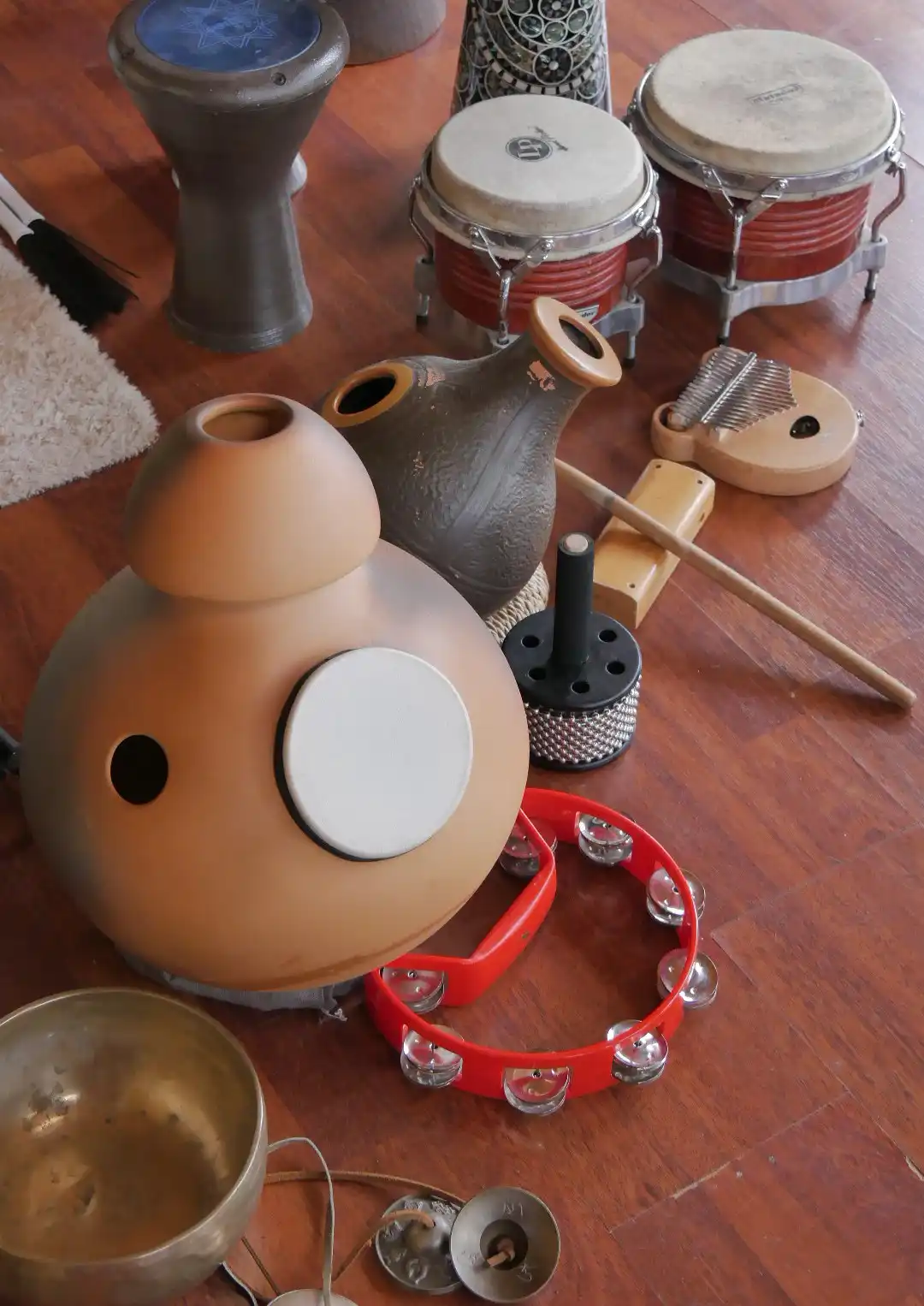
Bongos came into my musical life in the early 90s, when I was living in Oregon, USA.
Even if today they are not among the most popular instruments in my musical activities, I still get a lot of pleasure from making them sound with my hands or with chopsticks.
I’m always keen to explore the concept of musical integration.
Playing certain traditional instruments, such as bongos, on other styles of music fascinates me.
Nevertheless, their place in Cuban sounds, bolero, salsa and bachata remains predominant.
The must-haves are the various percussion instruments that are often small, unobtrusive, and easy to stow away.
I have a tambourine, cabassas, claves, a bowl, a cowbell, maracas, a kalimba, and an egg shaker… They accompany transitions and bring another to the musical signature.
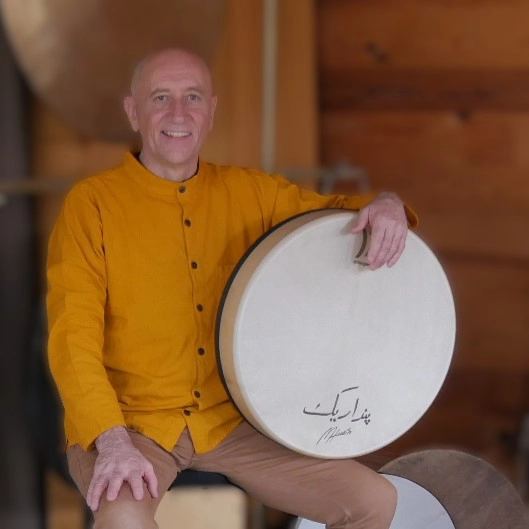
The daf is a traditional Persian instrument. I admire this instrument, which came into my life more recently.
The daf I play is a Westernized version of the frame drum. It is distinguished by its removable cymbalettes. The more traditional daf is fitted with small rings inside the frame.
I appreciate this version’s versatility; the goatskin can be stretched, which is important depending on the context in which I play.
Currently, I mainly use the daf for traditional Sufi rhythms, such as zikrs, as well as baijans, mantras, and dances for universal peace. However, it adapts well to Indian folklore and shamanic approaches.